ESG Data

ページタイトル

Coverage of ESG reporting

ESG data is compiled on a global consolidated basis, which includes Mitsui Kinzoku as well as domestic and overseas consolidated subsidiaries. Any differences are indicated in the notes.

About environmental data
・Totals do not add up in some cases due to rounding off of fractions.
・ A "–" is shown when data was not compiled for that year.
・ Part of the data for previous fiscal years have been revised due to a review of the calculation results.

About the scope of employee data
・Mitsui Kinzoku:Mitsui Kinzoku Company, Limited 
・Domestic (consolidated):domestic consolidated basis, which includes Mitsui Kinzoku as well as domestic consolidated subsidiaries.
・Global (consolidated):global consolidated basis, which includes Mitsui Kinzoku as well as domestic and overseas consolidated subsidiaries.
 

Environment

CO2・Energy

CO2 emissions from energy consumption (thousand t CO2
(Scope 1, 2)

  FY2020 FY2021  FY2022 FY2023 FY2024
Scope1 Japan
737   755  763  764  737 
Asia (except Japan) 35  33  32  31  32 
America (North, South and Central America)
Europe (including Morocco)
0.1  0.4  0.5  0.5  0.3 
Subtotal
779  797  802  804  778 
Scope2 Japan 707  692  661  661  572 
Asia (except Japan)
324  313  245  238  238 
America (North, South and Central America)
12 
Europe (including Morocco)
0.6   0.3 
Subtotal
1,044  1,015  918  907  815 
Total 1,823  1,812  1,720  1,712  1,593 
Per-unit energy-derived CO2 emissions
(per sales, t-CO2/million yen)
3.5  2.9  2.6  2.6   2.2 

CO2 emissions from energy consumption by business sector (thousand t CO2
(Scope 1, 2)

  FY2020  FY2021 FY2022  FY2023 FY2024
Scope1 Metals 642  654  661  672  658 
Engineered materials 59  59  49  45  47 
Mobility/Automotive parts & components 17  17  17 
Others/Affiliates coordination 76  81  76  71  56 
Mitsui Kinzoku Head Office and administrative sites 0.1  0.1  0.1  0.1  0.04 
Subtotal
779  797  802  804  778 
Scope2 Metals 589  558  563  574  500 
Engineered materials
375  372  254  243  233 
Mobility/Automotive parts & components
30  27  59  52  49 
Others/Affiliates coordination
48  56  40  37  33 
Mitsui Kinzoku Head Office and administrative sites
1.4  1.5  0.4 
Subtotal
1,044  1,015  918  907  815 
Total
1,823  1,812  1,720  1,712  1,593 
*1  Figures for CO2 emissions from energy consumption were calculated using emission factors derived in a manner conforming to the Act on Promotion of Global Warming Countermeasures. CO2 emissions from purchased electricity in Japan were calculated using the latest adjusted emission factors of electric power suppliers (basic emission factors were used until FY2019). For overseas emission factors, we used emission factors provided by power suppliers or specific locations. Where these were not available, we used the CO2 Emission Factors from Electricity reported by the IEA. (Until FY2020, the Electricity Emission Factors reported by GHG PROTOCOL were used.)
*2 Emissions from using waste as fuel are not included.

*3  We have received independent practitioner’s assurance for the energy-derived CO2 emissions calculation. 
        Independent practitioner’s assurance report  FY2020FY2021FY2022FY2023FY2024
*4  Figures for FY2022 onward by business sector were based on the new organization started in April 2022, and those until FY2021 were based on the old organization. Others include the organizations under the Business Reconstruction Office of the Corporate Planning Department, and the Business Creation Sector.

GHG emissions other than energy-derived CO2 (t-CO2, Scope 1)

    FY2020  FY2021  FY2022  FY2023
FY2024
Non-energy derived CO2
 Domestic 170,359   158,987  152,281  129,270  119,778 
   Overseas 143  180  184 
   Subtotal 170,359  158,987  152,424  129,450  119,962 
Methane (CH4)    Domestic 1,712  1,731  1,789  2,199  2,102 
   Overseas 28  63  37 
   Subtotal 1,712  1,731  1,818  2,262   2,139 
Dinitrogen monoxide (N2O)  Domestic 6,680  5,895  5,670  5,286  4,860 
   Overseas  -  50  139 
   Subtotal 6,680  5,895  5,720  5,294  4,999 
Total   178,751  166,613  159,962  137,006  127,100 

CO2 emissions from logistics and waste treatment (t-CO2) (Scope 3)

  FY2020  FY2021  FY2022  FY2023
FY2024
Logistics*1
19,703 18,496 18,163   17,518  15,906
Waste treatment *2
25,430 27,977 11,528   6,468 4,031
*1 Non-consolidated basis in Japan. Figures from FY2022 onward were obtained from calculation made for the Category 4 boundary of Scope 3.  Up to FY2021, the scope of data calculation covered the transportations designated as Specified Consigner by the Act on the Rational Use of Energy.
*2  Global consolidated basis. Figures for FY2022 onward were obtained from calculation made for the Category 5 boundary of Scope 3. Calculation was performed based on the Basic Guidelines on Accounting for Greenhouse Gas Emissions Throughout the Supply Chain using the emission factors by waste type/disposal method (excluding the waste transportation process) in the Emission Factor Database on Accounting for Greenhouse Gas Emissions Throughout the Supply Chain. For the emission factors up to FY2021, the emission intensity database for calculating GHG emissions of organizations throughout the supply chain, Japan‘s Ministry of the Environment and Ministry of Economy, Trade and Industry was referenced.

Energy consumption (crude oil equivalent in kl)

  FY2020  FY2021   FY2022 FY2023 FY2024
Domestic 555,306 581,007 564,547  542,486 526,217
Overseas 155,033 158,467 130,044 123,469  139,975
Total 710,339 739,474 694,591  665,955  666,191
Per-unit energy consumption
(per sales, kl
/million yen) 
1.4 1.2 1.1 1.0  0.9

Total power generation using renewable energy (GWh)

  FY2020  FY2021   FY2022 FY2023 FY2024
Hydraulic 267 272 277  266  279
Geothermal 132 107 107 103  112
Photovoltaic 5 6 7  17  13
Total 404 385 392  386  405

Waste, water, air and hazardous materials

Breakdown of usage by type of raw material (thousand tons)

  FY2020  FY2021   FY2022 FY2023 FY2024
Unused natural resources such as ore 1,878 2,168 2,004 2,333  2,115
Unused products, intermediate products and parts manufactured or processed in the Group 127 90  82  80  67
Unused products, intermediate products and parts manufactured or processed by other companies 952 1,354 1,051  959  622
Materials recycled from waste of products once used 627 713 659  656  637
Processing stage defective articles and processing losses 101 108 106  117  117
Total 3,684 4,432 3,902 4,145  3,558

Waste generation by types / disposal methods (thousand tons)

   FY2022 FY2023 FY2024
 Hazardous waste (Specially controlled industrial waste) 5.5  6.2  4.1
   Of which, recycling, reusing, and thermal use  4.7 5.4  3.2
   Of which, recycling  -  0.02  0.03
 Non-hazardous waste  (Industrial waste & Municipal waste) 31.3  28.8  27.9
   Of which, recycling, reusing, and thermal use 15.2 13.5  12.4
   Of which, recycling  - 7.4  9.0
 Total   36.8  35.0  32.0
    Of which, recycling, reusing, and thermal use 19.9 18.9  15.6
   Of which, recycling  -  7.4  9.1

*1 The amount includes recycling, reusing, and thermal use.
*2 Excluding tailings waste.

Amount of waste generation (excluding recycling)(thousand tons)

  FY2020  FY2021  FY2022 FY2023 FY2024
Domestic  16  19 16  15  14
Overseas 1 1 1 1  2
Total   18 20 17  16  16

*1 Waste generation, excluding recycling (recycling, reusing, and thermal use).
*2 Excluding tailings waste.

Amount of tailings waste generation (thousand tons)

  FY2020  FY2021  FY2022 FY2023
FY2024
Domestic 73  71 74 69  81
Overseas 250  336  311  464  476
Total    323 408  384 533  557

Amount of plastic waste generated (thousand tons)
 Breakdown and percentage of recycling

 
FY2021   FY2022 FY2023 FY2024
Plastic waste generated in processes for manufacturing plastic products   0.4  0.3  0.3  0.2 
 
 Of which, recycling 0.3   0.2  0.2  0.18 
Plastic packaging and packing materials generated in distribution or sales processes 0.9  0.9  0.9  0.9 
 
 Of which, recycling
0.3  0.3  0.4  0.4 
Other plastic waste generated in operations such as construction and manufacturing
0.9  0.9  0.8  0.9 
 
 Of which, recycling 0.2  0.1  0.1  0.1 
Total 2.2  2.1  2.0  2.0 
   Of which, recycling 0.8  0.6  0.7  0.7 

Volume of chemical substances released and transferred (tons/year)

  FY2020 FY2021 FY2022  FY2023
FY2024
Released Domestic 1,952  1,953  1,715  2,195   2,372 
Overseas 645  683  912  932 
Subtotal
1,952  2,598  2,398  3,107  3,305 
Transferred Domestic 447  602  553  713  696 
Overseas 11  24  37  34 
Subtotal 447  613  577  750  730 

Breakdown of chemical substances released and transferred

   Unit FY2023 FY2024
 Amount released into  Soil  t 0.3  0
 Public waters  t 94  95
 Atmosphere  t 153  188
   Of which, VOCs kg  11,257  11,517
   Of which, dioxins mg-TEQ
 239  238
   Of which, mercury and mercury compounds kg  187 214
   Of which, lead compounds  kg  941  1,943
   Of which, chromium and chromium compounds  kg  18  8
   Of which, cobalt and cobalt compounds  kg  0  0
   Of which, nickel compounds  kg  15  14
 On-site landfills  t  2,860  3,021
 Subtotal  t  3,107  3,305
 Amount transferred to

  
 Sewers t  0.05 0.04
 Waste t 750  730
 Subtotal t 750  730

*Calculated based on the PRTR system.

Emissions to the water (t)

   FY2020  FY2021   FY2022 FY2023 FY2024
BOD  Domestic 80  88  141  107  73 
Overseas 33  39  41  33  29 
Subtotal 113  127  182  140  102 
COD Domestic
130  128  183  166  139 
Overseas
98  115  112  91  88 
Subtotal 228  243  295  257  227 

Emissions to the atmosphere (t)

    FY2020 FY2021 FY2022 FY2023 FY2024
Soot and dust Domestic
73  90  80  74  79 
Overseas
14  28 
Subtotal 76   104   108  84  84 
NOx Domestic
407  460  470  452  444 
Overseas
28  34  99  135 
Subtotal
415  488  504  551  579 
SOx Domestic
181  193  241  201  216 
Overseas
10 
Subtotal
184  199  245  208  226 

Breakdown of water withdrawal (thousand m3)

  FY2023 FY2024
Surface water (rivers and others)
899  832 
Groundwater (including underflow water)
16,134  17,469 
Rainwater
676   864 
Industrial water (supplied from offsite)
6,960  7,081 
Tap water 4,466  4,522 
Seawater 83,684    76,514 
Total
112,820  107,283 

Breakdown of wastewater (thousand m3)

  FY2023 FY2024
Discharged into sea
85,512  79,001 
Discharged into rivers
53,379  63,306 
Percolated underground
Sewage and others
363  361 
Injected into deep wells
1,198  1,304 
Total 140,456  143,981 

* The Group's wastewater includes water used in manufacturing processes, as well as mine effluent from mining areas and on-site precipitation. The volume of mine effluent and on-site precipitation varies with changes in precipitation and other factors. Water from these sources that is not used for manufacturing is treated according to discharge standards and released into the sea, rivers, and other bodies of water under the control of each site.

Amount of circulated water usage (thousand m3

    FY2020  FY2021  FY2022  FY2023 FY2024
Reused (for the same purpose)
Domestic 19,368  19,796  20,130  18,299  18,740 
Overseas 2,791  2,618  2,276  2,823  2,920 
Subtotal 22,159  22,414  22,406  21,122  21,661 
Reused (for different purposes)
Domestic 8,370  8,714  9,704  9,846  10,229 
Overseas
Subtotal
8,375  8,719  9,707  9,849  10,232 
Recycled Domestic 1,003  1,154  1,251  1,536  1,517 
Overseas 813  1,155  985  937  1,035 
Subtotal 1,816   2,309  2,236  2,474  2,551 

Water withdrawal in water stressed areas (thousand m3)

  Water Stress Assessment FY2023 FY2024
Water Withdrawal  Percentage Water Withdrawal  Percentage
Extremely High (>80%) Areas 54  0.2%  55  0.2% 
High (40-80%) Areas 112  0.4%  105  0.3% 
Medium - High (20-40%) Areas 2,126  7%  1,984  6% 
Low - Medium (10-20%) Areas 25,381  87%  27,118  88% 
Low (<10%) Areas 1,462  5%  1,510  5% 
Total 29,135  100%  30,771    100% 

* Water Stress assessment provided by AQUEDUCT Water Risk Atlas 4.0. Excluding seawater.

Environmental Accounting, training and ISO

Environment-related capital expenditures and environmental management expenses
(Hundred million yen)

 
 FY2020 FY2021   FY2022 FY2023 FY2024
Environment-related capital expenditure Domestic 19  21 
Overseas
Subtotal
22  25 
Environmental management expense
Domestic 111  105  110  118  121 
Overseas
27  31  29  41  48 
Subtotal
138  136  139  160  168 

Break down of environmental management expenses
(Hundred million yen)

  FY2020  FY2021  FY2022  FY2023 FY2024
Waste treatment outsourcing expenses 11  137  12  12   11 
Energy expenses 33  36  39  51  48 
Maintenance and repair expenses 27  29  19  16  28 
Labor cost 10  10  11  12  13 
Analysis expenses
Others (office commodity expenses, etc.)
54  45  55 64  63 
Total
138  136  139  160  168 

Number of attendees in environmental training

  FY2020  FY2021   FY2022  FY2023  FY2024
Environmental training 110  325  236  214  216 
 Rank-based training
 (including environmental training) 
409  299 

*1 The number of attendees of environmental trainings held at the head office of Mitsui Kinzoku, including attendees from Mitsui Kinzoku and domestic and overseas consolidated subsidiaries.
*2 Not including environmental trainings held at sites.
*3 We combined rank-based environmental training and environmental training from FY2022.

Coverage of ISO14001

  FY2024 
Percentage of manufacturing sites  91% 
Percentage of all sites * 75% 
* All sites within the scope of global consolidation, including manufacturing sites, R&D center, sales sites and offices.

Social

Employees

Breakdown of consolidated employees by employment status and employment contract type
(as of the end of FY2023)

    Male Female Total
Open-ended workforce contract Full-time 9,277 3,441 12,718
Part-time 6 11 17
Total 9,283 3,452 12,735
Fixed-term contract Full-time 408 194 602
Part-time 56 41 97
Total 464 235 699
Total 9,747 3,687 13,434
Supervised workers 830 954 1,784
Total workforce 10,577 4,641 15,218

 Since the calculation method is different from the one for temporary employees stated in the annual securities report, the total number of employees is not in accord.

Breakdown of consolidated employees by employment contract(as of the end of FY2023)

  Open-ended workforce contract Fixed-term contract  
  Male Female Male Female Total
Japan 5,432 912 361 109 6,814
North America 227 157 0 0 384
South and Central America 685 452 9 2 1,148
Asia 2,889 1,897 94 124 5,004
Europe 50 34 0 0 84
Total 9,283 3,452 464 235 13,434

New employee hires by region(as of the end of FY2023)

    Under 30 years of age 30-49 years old 50 years of age or over  
    Male Female Male Female Male Female Total
Japan New hires 165 31 154 43 53 7 453
Total employees 798 151 2,875 474 2,135 331 6,764
Rate of hiring 20.7% 20.5% 5.4% 9.1% 2.5% 2.1% 6.7%
North America New hires 4 4 11 5 9 3 36
Total employees 14 3 81 51 119 102 370
Rate of hiring 28.6% 133.3% 13.6% 9.8% 7.6% 2.9% 9.7%
South and Central America New hires 210 132 107 95 11 14 569
Total employees 214 178 323 226 144 50 1,135
Rate of hiring 98.1% 74.2% 33.1% 42.0% 7.6% 28.0% 50.1%
Asia New hires 296 345 112 73 4 12 842
Total employees 833 377 1,870 1,504 213 138 4,935
Rate of hiring 35.5% 91.5% 6.0% 4.9% 1.9% 8.7% 17.1%
Europe New hires 26 1 21 8 15 4 75
Total employees 12 0 18 11 20 23 84
Rate of hiring 216.7% - 116.7% 72.7% 75.0% 17.4% 89.3%
Total New hires 701 513 405 224 92 40 1,975
Total employees 1,871 709 5,167 2,266 2,631 644 13,288
Rate of hiring 37.5% 72.4% 7.8% 9.9% 3.5% 6.2% 14.9%

 Since the calculation method is different from the one for consolidated employees, the total number of employees is not in accord.

Employee turnover by region(as of the end of FY2023)

    Under 30 years of age 30-49years old 50 years of age or over  
    Male Female Male Female Male Female Total
Japan Departures 46 8 65 12 145 12 288
Total employees 798 151 2,875 474 2,135 331 6,764
Turnover rate 5.8% 5.3% 2.3% 2.5% 6.8% 3.6% 4.3%
North America Departures 3 3 7 6 9 8 36
Total employees 14 3 81 51 119 102 370
Turnover rate 21.4% 100.0% 8.6% 11.8% 7.6% 7.8% 9.7%
South and Central America Departures 98 62 46 48 7 5 266
Total employees 214 178 323 226 144 50 1,135
Turnover rate 45.8% 34.8% 14.2% 21.2% 4.9% 10.0% 23.4%
Asia Departures 170 252 163 75 15 35 710
Total employees 833 377 1,870 1,504 213 138 4,935
Turnover rate 20.4% 66.8% 8.7% 5.0% 7.0% 25.4% 14.4%
Europe Departures 21 2 19 6 13 5 66
Total employees 12 0 18 11 20 23 84
Turnover rate 175.0% - 105.6% 54.5% 65.0% 21.7% 78.6%
Total Departures 338 327 300 147 189 65 1,366
Total employees 1,871 709 5,167 2,266 2,631 644 13,288
Turnover rate 18.1% 46.1% 5.8% 6.5% 7.2% 10.1% 10.3%

 Since the calculation method is different from the one for consolidated employees, the total number of employees is not in accord. Departures includes “retirement at the age limit” and “expiration of contract period”.

Breakdown of consolidated employees by position
(as of the end of FY2023)

  Under 30 years of age 30-49 years old 50 years of age or over  
  Male Female Male Female Male Female Total
Managerial 4 0 746 119 679 33 1,581
Non-managerial 1,880 713 4,469 2,188 1,969 634 11,853
Total 1,884 713 5,215 2,307 2,648 667 13,434

Percentage of managers holding local nationality in overseas sites(as of the end of FY2023)

North America 77.8%
South and Central America 83.3%
Asia 86.7%
Europe 100.0%
Total 86.2%

Proportion of women as a percentage of new hires

  FY2019 FY2020 FY2021 FY2022 FY2023
Mitsui Kinzoku 19.3% 15.0% 21.6% 19.0% 16.0%
Domestic (consolidated) 21.9% 18.5% 21.6% 19.0% 17.9%
Global (consolidated) 40.6% 46.6% 41.3% 37.1% 39.3%

Proportion of women as a percentage of total employees

FY2019 FY2020 FY2021 FY2022 FY2023
Mitsui Kinzoku 11.4% 11.2% 12.2% 13.5% 13.9%
Domestic (consolidated) 14.6% 13.9% 14.3% 14.6% 15.0%
Global (consolidated) 30.3% 28.6% 28.3% 27.6% 27.4%

Number of emloyees in management positions* by gender


FY2019 FY2020 FY2021 FY2022 FY2023
Mitsui Kinzoku Male 630 637 676 712 758
Female 14 16 21 20 29
Total 644 653 697 732 787
Domestic(consolidated) Male 1,066 988 1,103 1,165 1,217
Female 19 22 28 30 39
Total 1,085 1,010 1,131 1,195 1,256
Global(consolidated) Male 1,344 1,270 1,381 1,457 1,504
Female 115 119 125 137 152
Total 1,459 1,389 1,506 1,594 1,656

*At Mitsui Kinzoku, "employees in management positions"are defined as those at the "section manager level" or above.  For affiliated companies, the definition is based on each company's own criteria.

Proportion of women in management positions

  FY2019 FY2020 FY2021 FY2022 FY2023
Mitsui Kinzoku 2.2% 2.5% 3.0% 2.7% 3.7%
Domestic (consolidated) 1.8% 2.2% 2.5% 2.5% 3.1%
Global (consolidated) 7.9% 8.6% 8.3% 8.6% 9.2%

Wage gap between male and female workers

FY2022 FY2023
All workers Of which,
regular
Of witch, part-time and
fixed-term workers
All workers Of which,
regular
Of witch, part-time and
fixed-term workers
Mitsui Kinzoku 67.7% 70.5% 53.1% 69.1% 71.5% 57.6%
Domestic (consolidated) 63.5% 67.4% 53.7% 55.1% 59.3% 48.5%

*Calculated based on provisions in the Act on the Promotion of Women’s Active Engagement in Professional Life.

*Female workers are paid less than male workers, which is attributable principally to the smaller percentage of women in management positions and to the average length of service of women being shorter than that of men (by about seven years).

Average years of employment by gender

  FY2023
  All workers Of which,
regular
Of witch, part-time and
fixed-term workers
Mitsui Kinzoku Male 14.5 15.2 6.8
Female 7.5 8.0 3.5
Total 13.7 14.4 6.2
Domestic (consolidated) Male 15.1 15.5 10.2
Female 9.2 9.5 5.7
Total 14.2 14.7 9.2

Percentage of employees with disabilities

  FY2019 FY2020 FY2022 FY2022 FY2023
Mitsui Kinzoku 2.32% 2.10% 2.16% 2.36% 2.30%

Revised the values for previous years.

Rate of taking paid leave

  FY2019 FY2020 FY2021 FY2022 FY2023
Mitsui Kinzoku 79.0% 70.5% 71.1% 78.9% 80.6%
Domestic (consolidated) 76.7% 67.3% 69.3% 77.8% 80.3%

Overtime hours(Hours/month per employee)

  FY2019 FY2020 FY2021 FY2022 FY2023
Mitsui Kinzoku 13.7 13.2 14.0 13.8 12.5
Domestic (conslidated) 16.8 12.3 13.3 13.1 12.6

Parental leave

    FY2021 FY2022 FY2023
    Employees that entitled to leave Employees that took advantage Employees that entitled to leave Employees that took advantage Employees that entitled to leave Employees that took advantage
Mitsui Kinzoku Male 87 7 71 6 71 30
Female 17 17 15 15 11 11
Total 104 24 86 21 82 41
Domestic (consolidated) Male 184 15 175 21 140 62
Female 27 27 19 18 21 21
Total 211 42 194 39 161 83

 Employees that took advantage: Employees that took parental leave in the relevant fiscal year of those entitled.

Return to work and retention rates after parental leave

    FY2021 FY2022 FY2023
    Ended Returned Retired Ended Returned Retired Ended Returned Retired
Mitsui Kinzoku Male 5 4 1 7 7 0 26 26 0
Female 0 0 0 14 14 0 13 13 0
Total 5 4 1 21 21 0 39 39 0
Domestic (consolidated) Male 13 12 1 21 21 2 51 51 0
Female 2 2 0 20 20 0 13 13 0
Total 15 14 1 41 41 2 64 64 0

 Ended: Employees whose parental leave ended.
  Returned: Employees that returned to work after ended.
  Retired: Employees that separated from employment in twelve months after returning.

Results of stress check(Percentage of high stress)

  FY2019 FY2020 FY2021 FY2022 FY2023
Domestic (consolidated) 14.7% 13.3% 15.6% 14.5% 14.4%

 Target : Directly hired employees of Mitsui Kinzoku and
the domestic consolidated subsidiaries, including expatriate workers)

Human Rights

Number of attendees in human rights training

  FY2020 FY2021 FY2022 FY2023
Japan 360 311 0 0
Overseas 67 171

*Human rights training at overseas sites scheduled for FY2020 and FY2021 was postponed due to COVID-19
*A systematic review of human rights training has been underway since FY2023, and the new training program has been conducted since FY2024.

Health and Safety

Number of accidents

    2020 2021 2022 2023 2024
Mitsui Kinzoku Group*1 Serious accidents 1 0 0 0 0
Requiring days off 10 13 16 15 6
Not requiring days off 25 22 9 25 22
Total 36 35 45 40 28
Cooperative companies and contractors Serious accidents 1 0 0 1 0
Requiring days off 10 11 12 11 8
Not requiring days off 10 4 16 16 10
Total 21 15 28 28 18
*1 Directly hired employees on a global consolidated basis.
*2 Revised the classification of not requiring days off in previous years.

Number of attendees in safety training

  FY2020 FY2021 FY2022 FY2023 FY2024
Safety training 71 489 281 214 223
Rank-based training
(including safety training)
414 304 -  -  -
*1 The number of attendees of safety trainings held at the head office of Mitsui Kinzoku, including attendees from Mitsui Kinzoku and domestic and overseas consolidated subsidiaries.
*2 Not including those held at sites.
*3 We combined rank-based safety training and safety training from FY2022.

Community Engagement

Mitsui Kinzoku Group breakdown of the amount

Changes in Amount (Millions of yen)

  
  FY2019 FY2020 FY2021 FY2022 FY2023
Global(consolidated) 150.0 134.3 191.8 193.9 221.3
  

Intellectual Property

Number of patent applications

 Prior year reported figures updated as appropriate to reflect retrospective patent paperwork procedures and patent transfers.


Number of patents registered globally


 Numbers as of the end of March 2024.

Quality Management

Number of operating sites with certifications
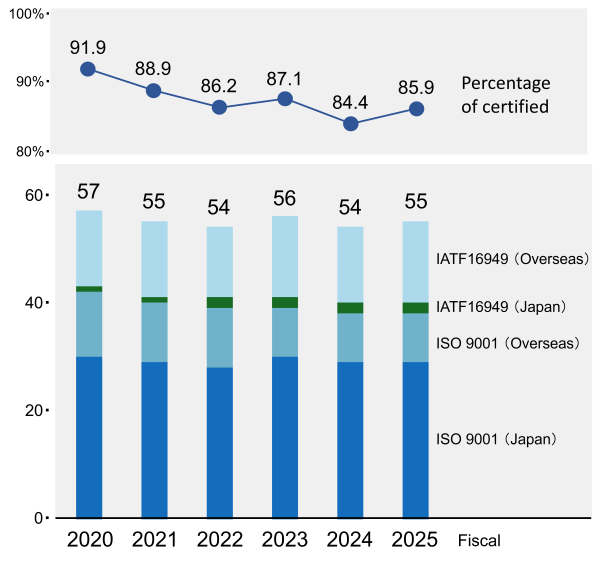
Number of claims at sites that hold QA meetings
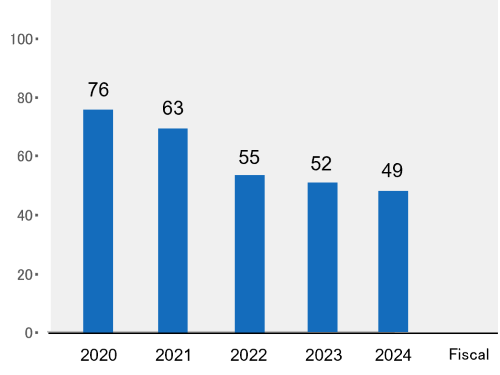

* The values expressed as relative values, with the data of FY2013 being 100.

Governance

Compliance

  FY2019 FY2020 FY2021 FY2022 FY2023
Report of punitive legal action taken against Mitsui Kinzoku with respect to anti-competitive practices  0 0 0 0 0
Report of punitive legal action taken against Mitsui Kinzoku with respect to bribery  0 0 0 0 0

Coverage of reporting
We use cookies to improve site functionality, provide you with a better browsing experience, and to enable our partners to advertise to you.
Detailed information on the use of cookies on this Site, and how you can decline them, is provided in our privacy policy.
By using this Site or clicking on "Accepted", you consent to the use of cookies.