Biodiversity Conservation
Mitsui Kinzoku Group’s business activities are both dependent on and influential to natural capital, including biodiversity. We benefit from ecosystem services such as water resources, energy, and soil in ore mining as well as in metal smelting and processing. However, wastewater, gas emissions, and land modification may also affect local ecosystems. In accordance with our Basic Environmental Policy, Mitsui Kinzoku Group strives to accurately assess the impact of its business activities on ecosystems and to minimize environmental impact through operational improvements and the adoption of new technologies. We are also fostering collaboration with local stakeholder in light of the natural environments in which we operate.
In April 2024, we commenced our involvement as a Forum Member of the Taskforce on Nature-related Financial Disclosures (TNFD). In October 2025, we registered as a TNFD Adopter.
In January 2025, we expressed our support for the Keidanren Declaration for Biodiversity and Guideline, and joined the Keidanren Initiative for Biodiversity Conservation.
Keidanren Declaration for Biodiversity and Guideline
Mitsui Kinzoku Group Nature Positive Declaration
| Reduction of Environmental Footprint |
- Identification of locations with biodiversity value near our operations
- Environmental assessment for new plant construction and equipment installation
- GHG emissions reduction
- Management of wastewater and emissions, and reduction of hazardous substance and waste, using voluntary standards as needed
- Introduction of a system for environmental contribution product
|
| Biological Habitat Preservation and Landscaping |
- Planting activities at suspended or closed mine sites
- Tree-planting activities at suspended or closed quarries
- Promotion of greening at each site and in neighboring areas
|
| Collaboration with Stakeholders |
- Activities at the Huanzala mine and the Pallca mine (in Peru)
- Donations to tree-planting activities by public organization (at our Chinese site)
- Release of juvenile fish with local fishermen's association (at our domestic site)
- Participation in volunteer cleanup activities (at domestic and overseas sites)
|
Initiatives in the Mining Business
Biodiversity conservation and land rehabilitation
Mitsui Kinzoku Group recognizes the impacts that mining operations can have on the surrounding environment and biodiversity. We have incorporated initiatives for biodiversity conservation and land rehabilitation into our Medium-Term Plan and the Sustainability Action Plan for our mining business. At each mining site, we carry out biodiversity risk assessments and initiatives such as soil-covering, revegetation, and tree planting in line with the life cycle of the mine, including development, operation, and closure.
Soil-covering and revegetation on former open-pit areas(Kamioka Mine)
At the Kamioka Mine, we are continuously conducting soil-covering and revegetationon former open-pit areas with the aim of restoring the landscape, reducing the generation of turbid water, stabilizing the terrain, and contributing to biodiversity.
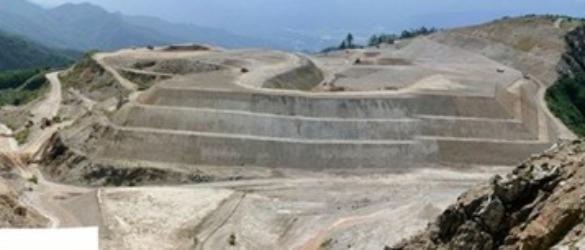
Before soil-covering and revegetation (Kamioka Mine, 2010)
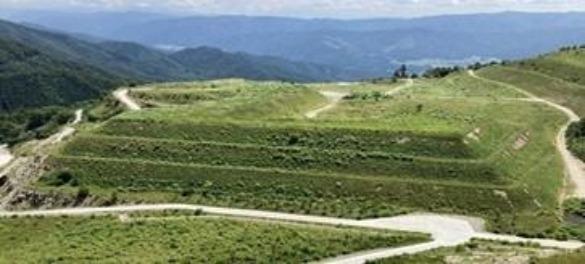
After soil-covering and revegetation (Kamioka Mine, 2024)
Utilization of company-owned forest (Kamioka Mine)
At the Kamioka Mine, with respect to our company-owned forests, we prepare a forest management plan in accordance with Japan’s Forest Act, and, in line with this plan, carry out appropriate management such as planting and thinning. Through this approach, we aim for forest management that fulfills the multiple functions of forests, including not only timber production but also biodiversity conservation.
In addition to planting broadleaf trees on non-forested land created after forest development for the purpose of conserving the mine area and the tending and management of existing broadleaf forests, we are working, according to site conditions, on converting coniferous forests into mixed conifer–broadleaf forests, developing multi-layered forests, and converting them into broadleaf forests.
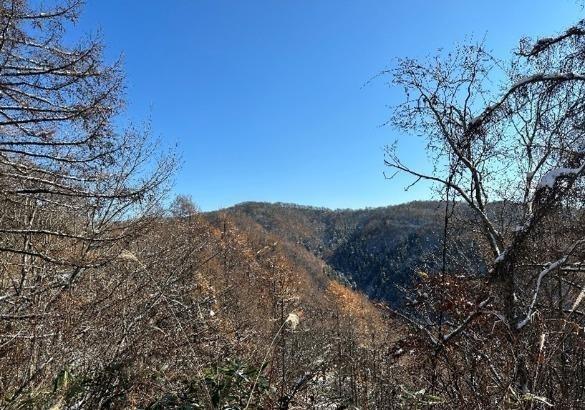
Company-owned forest (Kamioka Mine)
Biodiversity risk assessment
Mitsui Kinzoku Group conducts biodiversity risk assessments, in accordance with the regulations and laws applicable to the project area at the time of mine development and other relevant stages, in order to minimize impacts on the surrounding environment and biodiversity.
At sites in the Republic of Peru (the Huanzala Mine and the Pallca Mine), the surrounding areas are home to flora and fauna unique to high-altitude environments at elevations of over 4,000 meters. In accordance with Peru’s Law on the National Environmental Impact Assessment System, we conduct environmental baseline surveys and environmental impact assessments at the time of development, as well as when increasing production or changing operating areas. The Huanzala Mine and the Pallca Mine also conduct biannual surveys of flora and fauna on an ongoing basis and report the results to the supervisory authorities.
We also plan to carry out an environmental baseline survey and an environmental impact assessment for the ongoing Atalaya Project in preparation for applying for a mining permit.
At the Kamioka Mine in Gifu Prefecture, Japan, we cooperate in habitat surveys of raptors and other species organized by the local government. In addition, before implementing environmental mitigation works, we confirm the status of wildlife habitats, and for the two amphibian species confirmed to inhabit the construction area, we relocate and protect them in appropriate locations and continue to monitor their habitat conditions.
Overview of the survey at the Huanzala and the Pallca Mine
- Monitoring of fauna, flora, and aquatic biota: surveys of habitats, population sizes, and related parameters.
- Impacts on biodiversity and local communities: surveys of environmental impacts associated with mine operations (including impacts on soil, air, noise and vibration, and water quality) and of impacts on local communities’ economy and employment, landscape, and traditional customs and lifestyles.
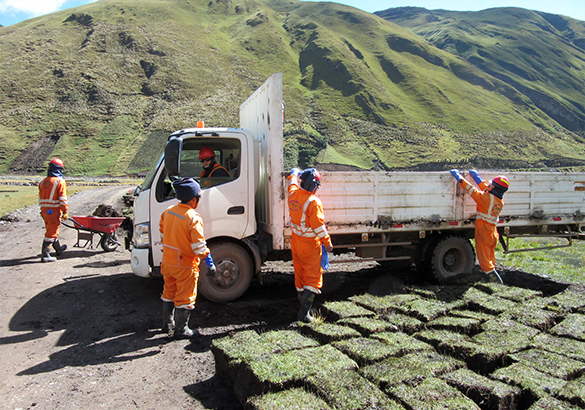
In 2019, due to the construction work to expand the tailings dam, we carried out the transplantation of wetland vegetation groups (bofedal) in collaboration with experts and the relevant government agencies.(Huanzala Mine)
Initiatives to enhance awareness of biodiversity
At the Huanzala Mine, training on biodiversity is provided to employees upon joining the company and once a year thereafter. For local residents, pamphlets on local fauna and flora are distributed to promote awareness of biodiversity. In FY2024, a tree-planting event was held for local students.
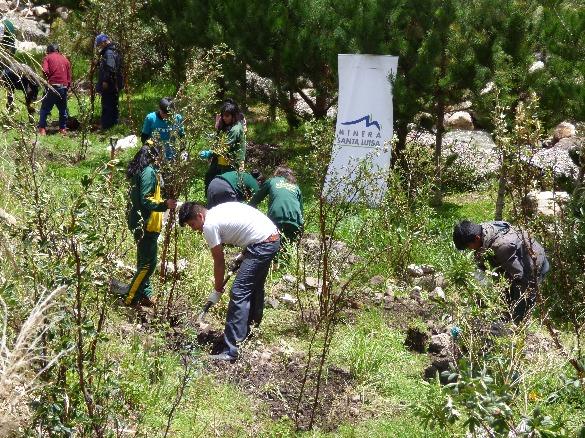
Tree-planting event for local students (Huanzala Mine)
Mining business
Preliminary study for TNFD disclosure
In FY2024, we conducted a preliminary study to prepare for disclosure in line with the TNFD recommendations. In this study, we applied the LEAP approach*1 recommended by the TNFD to analyze three key sites with strong interconnections to the natural environment. Using ENCORE*2, we evaluated our dependence and impact on natural capital at the industrial sector level, and also assessed site-specific relationships with natural capital using the WWF Risk Filter and IBAT*3.
Based on the results of the study, we concluded that operational management at the three sites has been appropriate, with no significant impact on local ecosystems. Beginning in FY2025, we will initiate disclosures in alignment with the TNFD recommendations, grounded in a more comprehensive evaluation of our relationship with natural capital across the entire value chain.
Overview of preliminary study results
| |
Identified dependencies
|
Identified impacts |
| Metal smelting plant in Japan |
-
Due to the characteristics of recycling-based smelting, the process has limited dependence on ecosystem services in the surrounding area.
|
- GHG emissions
- Amount of landfill waste*4
|
| Engineered materials plant in Japan |
- Groundwater withdrawal volume
|
- Amount of landfill waste*4
|
Overseas ore mining site
|
- The process has limited dependence on ecosystem services in the surrounding area.
|
- Efforts to reduce the environmental footprint of mining operations have resulted in a relatively low overall impact.
|
*1 An approach consisting of four phases: Locate, Evaluate, Assess, and Prepare.
*2 Exploring Natural Capital Opportunities, Risks and Exposures
*3 Integrated Biodiversity Assessment Tool
*4 Potential impacts in areas surrounding the landfill disposal sites.