Fundamental Principles
Mitsui Kinzoku views corporate governance as one of its most important managerial tasks that Mitsui Kinzoku shall strive to improve organizational structures and systems for management, and implement various measures as necessary, based on the recognition that corporate governance is a system for making fair and transparent decisions in a rapid and decisive manner, taking into consideration the positions of the stakeholders, including shareholders, customers, employees and local communities in order to achieve Our Vision of “Building new businesses-and the future-with our material intelligence. ” based on Our Purpose of “We promote the well-being of the world through a spirit of exploration and diverse technologies. ” under Our Management Philosophy of “ With creativity and productivity, We, Mitsui Kinzoku Group, will explore products of value to society, and seek an eternal growth of our group. ” Corporate governance is the foundation for sustaining the long-term value creation of Mitsui Kinzoku Group.
Pursuing its objective of “making a contribution to all stakeholders,” the Company executes policies throughout the business group by focusing on the following:
- Providing shareholders with payments of sound dividends consistent with the Company’s performance, and disclosing information in an appropriate manner
- Providing customers with high-value products
- Establishing harmonious and mutually prosperous relationships with local communities
- Creating a rewarding working environment and working conditions for employees
Moreover, as an institutional foundation that enables the Company to carry out fair and valuable business activities, the Company has been taking the following measures and other measures.
- Establishing various company regulations and rules, including the Code of Ethics
- Election of Outside Directors
- Introducing various audit systems and whistle-blowing systems
Corporate Governance System
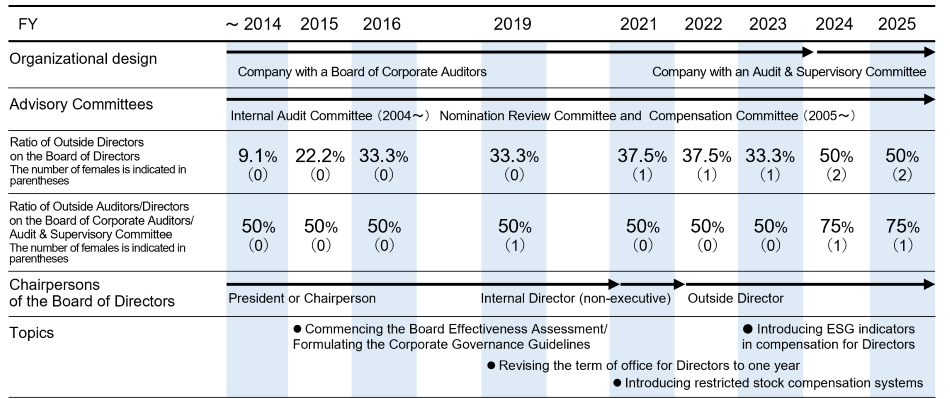
The Company previously operated its Board of Directors mainly with Executive Directors who concurrently serve as Executive Officers. However, for the purposes of accelerating decision-making on management matters, prioritizing the agenda of the Board of Directors so as to enhance discussions on management policies and strategies, and strengthening the Board’s supervisory function over management, the Company transitioned to a company with an Audit & Supervisory Committee pursuant to a resolution of the 99th Annual General Meeting of Shareholders held on June 27, 2024. At the same time, half of the Directors were made Outside Directors, and we appoint as Outside Directors only those who meet the criteria for independence of outside officers determined by the Company, from whom we receive valuable advice and opinions at meetings of the Board of Directors and other bodies.
In order to separate the Board of Directors’ supervisory function over management from its business execution function, the chairperson of the Board is elected by mutual election of the Directors, and an Outside Director (TOIDA Kazuhiko) has served as chairperson of the Board since the Board meeting held on June 29, 2022.
The Nomination Review Committee and the Compensation Committee are both composed of a majority of Outside Directors and are chaired by an Outside Director. Under this structure, the Nomination Review Committee deliberates on matters such as the qualification requirements for Directors (skills matrix), nomination of candidates, succession planning, and the composition of the Board of Directors, while the Compensation Committee determines the amount and other details of compensation for each Director. Through these initiatives, we enhance the supervisory function of the Board of Directors and further strengthen independence and objectivity in the nomination and evaluation of Directors.
In addition, we have established a support framework to enable Outside Directors to fully perform their roles, thereby ensuring appropriate and effective supervision and monitoring in the course of decision-making by the Board of Directors.
Overview of the corporate governance system
| Organizational Structure |
Company with an Audit & Supervisory Committee |
| Number of Directors (of which, number of Outside Directors) |
10 (5), including Directors who are Audit & Supervisory Committee Members |
| Number of Directors who are Audit & Supervisory Committee Members (of which, number of Outside Directors) |
4 (3) |
| Term of Office of Directors (excluding Directors who are Audit & Supervisory Committee Members) |
1 year |
| Term of Office of Directors who are Audit & Supervisory Committee Members |
2 years |
| Chairperson of the Board of Directors |
Outside Director |
| Chairperson of the Audit & Supervisory Committee |
Full-time Director who is an Audit & Supervisory Committee Member |
| Voluntarily Established Advisory Committees, etc. |
Nomination Review Committee (Chairperson: Outside Director who is an Audit & Supervisory Committee Member),
Compensation Committee (Chairperson: Outside Director who is an Audit & Supervisory Committee Member),
Internal Audit Committee (Chairperson: Director in charge of the Internal Audit Dept.) |
| Introduction of an Executive Officer system |
Introduced |
| Financial auditor |
KPMG AZSA LLC |
(as of June 27, 2025)
Corporate governance system of Mitsui Kinzoku
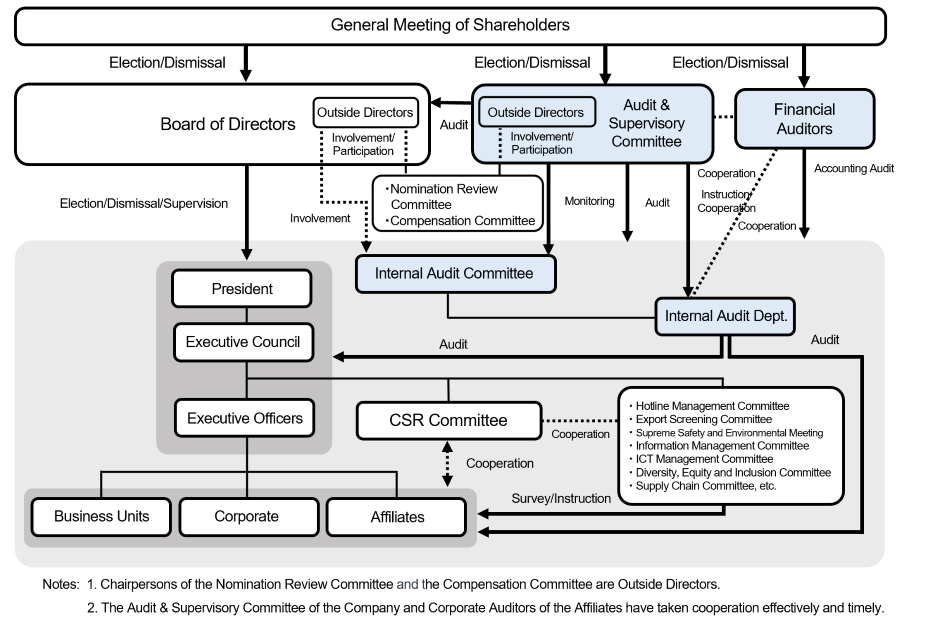
CSR Committee
History of corporate governance reform at Mitsui Kinzoku
Directors and Board of Directors
Board of Directors
The Board of Directors aims to strengthen the mechanism to effectively supervise initiatives to address medium- to long-term management issues and speed up the decision-making process. The Board of Directors consists of ten Directors, half of whom (five, including two women, three of whom are Directors who are Audit & Supervisory Committee Members) are Outside Directors. Outside Directors are appointed with consideration of their independence and ability to reflect diverse stakeholders’ perspectives.
Composition of Directors (Total: 10)
| |
Male |
Female |
| Directors (excluding Directors who are Audit & Supervisory Committee Members) |
| Number of Internal Directors |
4 |
0 |
| Number of Outside Directors |
1 |
1 |
Directors who are Audit & Supervisory Committee Members
|
| Number of Internal Directors |
1 |
0
|
| Number of Outside Directors |
2 |
1 |
| Total |
8 |
2 |
Ensuring Independence and Objectivity ー Ratio of Outside Directors:50%
Strengthening Management Supervision ー Ratio of Non-Executive Directors:60%
Promoting Diversity ー Ratio of Female Directors:20%
Board of Directors
List of regular agenda items of the Board of Directors
| Month |
Agenda Item |
| Apr |
Executive and senior management appointments |
| May |
Status of the operation of whistle-blowing systems |
| Jun |
New structure following the Meeting of Shareholders |
| Jul |
ー |
| Aug |
ー |
| Sep |
Status of initiatives on human capital |
| Oct |
ー |
| Nov |
Status of the operation of whistle-blowing systems |
| Dec |
Disclosure of the shareholder newsletter |
| Jan |
ー |
| Feb |
ー |
| Mar |
Report on the results of the Board Effectiveness Assessment |
In addition to the agenda items mentioned above, the Board of Directors regularly receives reports on the situation regarding each business sector and corporate unit.
Skills matrix of Director
The skills shown in the skills matrix below have been selected by the Nomination Review Committee as the skills necessary for promoting the Purpose, Vision, and executing the 2025-2027 Medium Term Business Plan.
Skills matrix of each Director
〇 indicates skills possessed by the Directors and Audit & Supervisory Committee Members,
while ◎ indicates skills the Company expects Directors and Audit & Supervisory Committee Members to demonstrate in particular.
Board Effectiveness Assessment
We conduct the Board Effectiveness Assessment every year to ensure the continuous enhancement of the board’s function.
We set the percentage of addressed issues identified at the Board Effectiveness Assessment in the previous year as KPI, and, in addition to following up on the assessment results at Board meetings, we have continuously monitored them at Top Management Meetings attended by all Board members and on other occasions, in order to drive improvements.
Assessment process
-
Step1
The Secretariat of the Board of Directors interviewed all Board members.
-
Step2
Based on the interview results, a third-party institution conducted a survey and interviews.
-
Step3
The following members participated in discussions.
・Board chairperson
・Representative Directors
・Director in charge of the secretariat
・Full-time Director who is an Audit & Supervisory Committee Member
・Secretariat of the Board of Directors
-
Step4
The Board of Directors deliberated at its meeting in March.
-
Step5
All Board members exchanged their opinions and then confirmed the assessment results and future actions.
Mechanisms Supporting Directors and the Board of Directors
Voluntarily Established Advisory Committees
Nomination Review Committee
Mitsui Kinzoku has established a Nomination Review Committee, which is chaired by an Outside Director and composed of Outside Directors, the President, and the Director in charge of the Human Resources Department (or Senior Executive Officer). The Committee reviews candidates to serve as Directors by considering their capabilities, knowledge, and character comprehensively using the skills matrix, and those deemed capable of satisfactorily fulfilling the responsibilities are nominated by the Board of Directors.
Compensation Committee
Mitsui Kinzoku has established a Compensation Committee which is chaired by an Outside Director and composed of Outside Directors, the President, and the Director in charge of the Human Resources Department (or Senior Executive Officer). The Committee establishes and revises the criteria for determining the amounts of base compensation and performance-linked compensation for Directors, and determines the amounts of compensation for each Director.
Executive Officer system
Executive Officer
The Company, in order to enhance the agility and flexibility of business execution and increase the vitality of management, introduced the Executive Officer system and delegated a significant portion of the decision-making regarding important business execution of the Company to the President and other Executive Officers, in accordance with the articles of incorporation and internal regulations such as “Assignment of Responsibilities for Management” on “Regulations for the Board of Directors (Torishimariyaku-kai kisoku)” and other rules. The Executive Officers are responsible for making decisions and execution of business activities.
The President and Representative Director assumes not only executive management responsibilities, but also executive responsibilities for business operations of Mitsui Kinzoku Group. Representative Directors and Executive Directors also serve as Executive Officers of Mitsui Kinzoku.
Board of Directors
Executive Council
The Council is composed of Senior Executive Officers (including those who concurrently serve as Directors), and deliberates in advance on matters to be resolved by the Board of Directors and discusses important matters related to business execution. Based on the results of these discussions, the Executive Officers make decisions and direct business operations.
Communication and training of Directors and Executive Officers
Top Management Meeting
We have established a communication forum where all members of the Board of Directors, including Outside Directors, discuss in advance particularly important management strategies and medium- to long-term issues to be deliberated upon at Board of Directors meetings. We organize the issues in order to streamline and improve discussions at Board of Directors meetings and to strengthen communication between Directors.
Training program for Directors and Executive Officers
We hold executive training for Directors and Executive Officers when they are appointed and on an ongoing basis during their term of office, in order to provide them with the information and knowledge on business activities that are necessary to supervise management.
Dialogue between Outside Directors and institutional investors
We hold meetings as forums for dialogue between Outside Directors and institutional investors in Japan. In FY2025, we held meetings with a total of seven institutional investors, at which the Outside Directors explained and answered questions from them regarding matters including the cost of capital and capital efficiency, the review of the business portfolio, the composition of the Board of Directors and the effects of changes in institutional design, and human capital.
Compensation for Directors
Compensation system
Compensation for Directors (excluding Outside Directors and Directors who are Audit & Supervisory Committee Members) consists of base compensation, performance-linked compensation as a short-term incentive, and stock compensation as a medium- to long-term incentive, to enable them to demonstrate management supervisory functions at a high level. In order to ensure competitiveness, the appropriateness of the level and composition of compensation for Directors is examined each year by comparing with other companies of similar size in terms of sales and market capitalization, as disclosed in the findings of a compensation survey in which major companies in Japan participate.
If the Board of Directors resolves a correction to the financial results post-announcement due to material accounting error or fraud, the Compensation Committee shall deliberate on adjustments to performance-linked compensation and restrict its payment, or even demand pay back of compensation, when deemed necessary (clawback provision).
Compensation for Directors (excluding Outside Directors and Directors who are Audit & Supervisory Committee Members)
(1) Base Compensation
The base compensation for the President is set, taking into consideration the Company’s performance, corporate value, and other factors comprehensively. Base compensation for Directors is calculated depending upon titles, based on the base compensation for the President and by applying a ratio for each title according to responsibilities.
(2) Performance-linked Compensation
Regarding performance-linked compensation, the amount of performance-linked compensation is calculated using consolidated ordinary income and ROIC, which the Company considers as key indicators for evaluating operating results, as the performance indicators. The benchmark is set at ¥40 billion, which is 130% of ¥30 billion, the average past consolidated ordinary income excluding the impact of the impairment from the Caserones Copper Mine. The Compensation Committee also sets ¥60 billion, which is the largest recorded profit, as a target, and sets an upper limit of ¥100 billion in the event that the target is exceeded, to ensure that performance-linked compensation serves as an appropriate incentive.
(3) Stock Compensation
The Company has introduced a restricted stock compensation plan (tenure-based restricted stock compensation) and ESG indicator-based restricted stock compensation for Directors to serve as an incentive for Directors to aim for continuous growth in corporate value and further enhance value-sharing with shareholders. In both cases, continued service is a condition for lifting the transfer restrictions.
The total amount of compensation for granting restricted stock shall be within ¥50 million per year as tenure-based stock compensation and within ¥50 million per year as ESG indicator-based stock compensation, totaling within ¥100 million per year. The total annual number of the Company’s common shares to be issued or disposed of by this shall be 16,650 shares or less per year as tenure-based stock compensation and 16,650 shares or less per year as ESG indicator-based stock compensation, totaling a maximum of 33,300 shares per year.
*Composition of ESG Indicators
| ESG |
Indicator |
KPI |
| E |
GHG reduction |
Formulation of a GHG reduction plan up to FY2030 and achievement of annual targets |
| Environmental initiatives |
CDP climate change score
|
| S |
DE&I |
Percentage of female managers |
| Promotion of job satisfaction |
Engagement score |
| G |
Governance |
Percentage of addressed issues identified at the Board Effectiveness Assessment |
| Compliance |
Presence of serious compliance violations |
Composition of compensation
(excluding Outside Directors and Directors who are Audit & Supervisory Committee Members)

*Composition of compensation when consolidated ordinary income is ¥40 billion and all KPIs are achieved for ROIC and ESG.
The percentage of base compensation, the percentage of performance-linked compensation and the percentage of stock compensation vary because performance-linked compensation varies according to the Company’s performance.
Compensation for Outside Directors and Directors who are Audit & Supervisory Committee Members
The compensation for Outside Directors and Directors who are Audit & Supervisory Committee Members consists only of base compensation and non-performance-linked stock compensation, considering their roles and independence. The compensation for Directors who are Audit & Supervisory Committee Members is determined through discussions by the Audit & Supervisory Committee.
Composition of compensation
(Outside Directors and Directors who are Audit & Supervisory Committee Members)

Revision of Directors' Compensation System for FY2025
The Compensation Committee has been working on designing a Directors' compensation system that contributes to the improvement of sustainable corporate value, and the Company revised its Directors’ compensation system for FY2025.
Overview of the revisions
(Performance-linked Compensation)
・In addition to consolidated ordinary income, which has been used as a performance indicator to date, ROIC has been newly added as a metric.
・The upper limit of performance-linked compensation tied to consolidated ordinary income has been raised from ¥80 billion to ¥100 billion.
・Additions to or deductions from performance-based bonuses for business-responsible Directors based on the performance of their respective departments have been abolished.
(Stock Compensation)
Tenure-based restricted stock compensation has been newly introduced for Outside Directors and Directors who are Audit & Supervisory Committee Members.
Total amount of compensation (FY2024)
Notes: 1. The Company’s 99th Annual General Meeting of Shareholders held on June 27, 2024, shareholders resolved to set the limit of compensation for Directors at ¥720 million per year (¥100 million per year for Outside Directors). Shareholders also resolved that when allocating such stock, the Company shall conclude a contract for allocation of restricted stock with the eligible Directors. The number of eligible Directors under this resolution was six (two of whom were Outside Directors).
2. At the 99th Annual General Meeting of Shareholders on June 27, 2024, shareholders resolved to set the limit of compensation for Directors who are Audit & Supervisory Committee Members at ¥180 million per year. The number of eligible Directors who are Audit & Supervisory Committee Members under this resolution was four (three of whom were Outside Directors).
3. At the 96th Annual General Meeting of Shareholders on June 29, 2021, shareholders resolved to set the limit of compensation for Directors who are Corporate Auditors at ¥180 million per year. The number of eligible Corporate Auditors under this resolution was four (two of whom were Outside Directors).
4. The above table includes four Directors (including one Outside Director) and four Corporate Auditors (including two Outside Directors) who retired at the conclusion of the 99th Annual General Meeting of Shareholders held on June 27, 2024. The Company transitioned from a Company with a Board of Corporate Auditors to a Company with an Audit & Supervisory Committee on June 27, 2024.
Total compensation and types of compensation for President (FY2024)
Audit & Supervisory Committee
Overview of the Audit & Supervisory Committee
The Audit & Supervisory Committee is composed of all Directors who are Audit & Supervisory Committee Members. The Committee holds regular meetings prior to monthly Board of Directors’ meetings, and extraordinary meetings as necessary. The Committee determines the annual audit plan, and audits the Directors’ business execution in accordance with the plan. In addition to receiving reports on the accounting audit plan and audit results from the Financial Auditors, the Committee exchange opinions with them on a regular basis to maintain close cooperation.
List of regular agenda items of the Audit & Supervisory Committee
| Month |
Agenda Item |
| Apr |
・Conclusion of the audit for the previous fiscal year and decision on the audit plan for the current fiscal year
・Agreement on the reappointment of Financial Auditors |
| May |
Submission of the audit report |
| Jun |
New structure following the Meeting of Shareholders |
| Jul |
ー |
| Aug |
ー |
| Sep |
ー |
| Oct |
ー |
| Nov |
ー |
| Dec |
Agreement on Financial Auditors’ compensation |
| Jan |
ー |
| Feb |
ー |
| Mar |
・Conclusion of the audit for the current fiscal year and decision on the audit policy for the next fiscal year
・Audit & Supervisory Committee Effectiveness Assessment |
Improvement of environment for the Audit & Supervisory Committee’s audits (e.g. Meeting with Senior Management)
In addition to the monthly Committee meetings, the Audit & Supervisory Committee also meets with Representative Directors, Executive Directors, and the heads of departments. These meetings are also attended by Outside Directors who are not Audit & Supervisory Committee Members to ensure that all Non-Executive Directors gain a timely understanding of management policies and share information.
Audit & Supervisory Committee Effectiveness Assessment
We conduct the Audit & Supervisory Committee Effectiveness Assessment every year to ensure the continuous enhancement of the committee’s function.
Assessment process
-
Step1
The Secretariat of the Board of Directors interviewed all Board members, including Audit & Supervisory Committee Members.
-
Step2
Based on the interview results, a third-party institution conducted a survey and interviews.
-
Step3
The following members participated in discussions.
・Board chairperson
・Representative Directors
・Director in charge of the secretariat
・Full-time Director who is an Audit & Supervisory Committee Member
・Secretariat of the Board of Directors
-
Step4
Discussions were held at the Audit & Supervisory Committee in March, where the members evaluated the results and decided on the audit plan for the next fiscal year.
-
Step5
The results were reported at the Board of Directors meeting in March, together with the Board Effectiveness Assessment.
Internal Audit Committee and Internal Audit Dept.
Internal Audit Committee
Mitsui Kinzoku organizes an Internal Audit Committee chaired by the Representative Director in charge of the Internal Audit Dept. and comprised of the head of the Internal Audit Dept., head of the Corporate Unit, General Managers of each sector’s Administration Department, and others. The Committee approves the policy and plan for internal audits conducted by the Internal Audit Dept. and evaluates the results. The results of audits approved and evaluated by the Internal Audit Committee are reported to the Board of Directors and the Audit & Supervisory Committee without delay through the Internal Audit Dept. and to Financial Auditors as appropriate.
In principle, all Directors who are Audit & Supervisory Committee Members attend Internal Audit Committee meetings as observers to monitor the activities of the Internal Audit Committee as the Audit & Supervisory Committee.
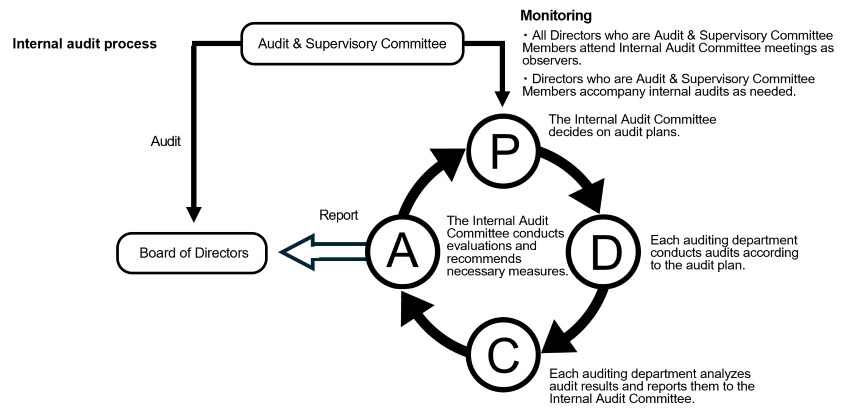
Internal Audit Dept. and internal audits
The Internal Audit Dept., positioned directly under the Director in charge of the Internal Audit Dept., functions as a body independent from other business execution departments to conduct internal audits on the Company’s overall business from an independent perspective. In addition to audits approved and evaluated by the Internal Audit Committee, we have also established a system that allows the Audit & Supervisory Committee to directly instruct the Internal Audit Dept. Through this system, the Internal Audit Dept. may also conduct internal audits as an independent body without going through the Internal Audit Committee.
Internal audits are conducted by members of the Internal Audit Dept. and internal audit staff (assigned by Internal Audit Committee Members), who visit each business division and site of the Company as well as its affiliates in Japan and overseas. They review a range of issues chiefly related to the situation regarding legal compliance, establishment status of internal control systems, and appropriateness of accounting processes.
Basic Approach to Internal Control Systems
The Company believes that conducting fair business activities that observe corporate ethics and comply with laws and regulations is essential if the Company is to achieve long-term development and sustained growth.
Based on this belief, we disclose an outline of the matters resolved by the Board of Directors regarding the structure to ensure the appropriateness of operations within the Mitsui Kinzoku Group.
Systems for Ensuring Appropriate Business Operation
(1)System for ensuring that the execution of duties by the Directors and employees of the Company and its subsidiaries is in compliance with relevant laws and regulations and the Company’s Articles of Incorporation
A) To ensure that the conduct of business activities by the Directors and employees of the Company and its subsidiaries is in compliance with relevant laws and regulations and the Company’s Articles of Incorporation, the Company clarifies and promotes its compliance system by instituting its “Code of Conduct,” which Directors and employees are required to observe, and internal regulations.
B) The Company clearly defines the authority of the Directors through the issuance of internal regulations, including “Regulations for the Board of Directors (Torishimariyaku-kai kisoku).” Also, by appointing Outside Directors who have a high degree of independence, the Company increases transparency and creates a framework to ensure that the Directors execute their duties appropriately.
C) In addition, the Company conducts internal audits of accounting, tax affairs, legal affairs, safety, quality, facilities, the environment, hygiene, ICT, etc. for the purpose of maintaining soundness of overall internal control among others.
(2)Systems for storing and safekeeping of information related to the execution of the duties of the Directors
For information related to the execution of the duties of the Directors, the Company has prepared, stores, and keeps in custody such information according to laws and regulations, the “Regulations for the Board of Directors (Torishimariyaku-kai kisoku),” “Regulations for Information Management (Jouhou kanri kisoku),” “Regulations Regarding Documentation (Bunsho kisoku),” regulations concerning ICT governance, and other internal regulations.
(3)Regulations and systems concerning the management of losses and hazards of the Company and its subsidiaries
To prevent the materialization of risks related to the execution of business activities of the Company and its subsidiaries and to respond to risks that have already materialized, based on its “Regulations for Risk Management (Risk management kisoku),” the Company designates organizational units in charge of each type of risk to monitor and evaluate the risks that may arise in the business activities of the Company and subsidiaries, decides on policies for risk management, and implements measures to deal with risks when they materialize.
The Company establishes “Regulations for Emergency Responses (Kinkyu-jitai hasseiji no taiou ni kansuru kisoku)” to protect human lives and assets and to swiftly recover and continue business in the event of a large disaster.
(4)Systems to ensure that the Directors of the Company and its subsidiaries execute their duties efficiently
As the basis for systems that ensure the Directors execute their duties efficiently, the Board of Directors holds a regular meeting once a month, and at other times as necessary. In addition, the Company determines assignment of responsibilities for management within the “Regulations for the Board of Directors (Torishimariyakukai-kisoku)” and clarifies the approving authorities, including those of subsidiaries, and transfer of authority to executive departments, with an aim to enhance the efficiency of decision-making. Also, through the introduction of the Executive Officer system, the Company endeavors to accelerate the execution of business activities.
(5)Systems for reporting to the Company of matters related to the execution of duties by Directors of the Company’s subsidiaries
The Regulations for the Board of Directors (Torishimariyakukai-kisoku) stipulate the assignment of responsibilities for management and the Regulations for the Management of Subsidiaries and Affiliates (Kankei-gaisha kanri kisoku). Regulations state that the Company’s relevant business divisions should give regular reports on certain important management matters related to operating results, financial conditions, and other matters, and that matters that meet certain criteria should be submitted to the Board of Directors of the Company for resolution.
Subsidiaries of the company establish and design internal control systems based on autonomous internal control, share information with the Company, and seek to enhance internal control measures. The Company’s relevant business divisions confirm the status of internal control at each Group company and provide support for improvement as necessary.
(6)Matters concerning employees who are to assist the duties of the Audit and Supervisory Committee and matters related to ensuring the independence of such employees from Directors and effectiveness of instructions given by Directors who are Audit and Supervisory Committee Members to such employees
A) Under the Company’s “Regulations for Company Organization Systems (Kaisha shokusei kisoku),” the Company establishes an Audit and Supervisory Committee Support and assigns employees to assist the Audit and Supervisory Committee in its duties. The Audit and Supervisory Committee Support is composed of several dedicated employees. Decisions regarding personnel transfers, performance evaluations, commendations, and disciplinary actions for such employees are made with reference to the opinions of the Audit and Supervisory Committee.
B) The employees who are assigned to assist the duties of the Audit and Supervisory Committee shall do so in accordance with the “Regulations for Company Organization Systems (Kaisha shokusei kisoku).” At Audit and Supervisory Committee meetings, such employees shall receive instructions from Directors who are Audit and Supervisory Committee Members, and also shall report on the progress of matters that they were instructed to address, and provide information.
(7)Systems for reporting to the Audit and Supervisory Committee
A) When the Directors and employees of the Company and Directors, Corporate Auditors, and employees of the Company’s subsidiaries discover facts that may cause serious losses to the Company, or when other events occur concerning the matters requiring reporting specified by the Audit and Supervisory Committee, they shall report to the Audit and Supervisory Committee.
B) Upon auditing of subsidiaries by Directors who are Audit and Supervisory Committee Members, Directors, Corporate Auditors, and employees of the Company’s subsidiaries shall report the status of operations and other matters required by the Directors who are Audit and Supervisory Committee Members.
C) Regarding the details of reports made via the whistle-blowing system, a system shall be set up to ensure prompt sharing of information with the Audit and Supervisory Committee.
(8)Systems to ensure that persons are not treated disadvantageously for making reports to the Audit and Supervisory Committee
The Company shall not engage in detrimental treatment of Directors and employees of the Company and Directors, Corporate Auditors, and employees of the Company’s subsidiaries who reported to the Audit and Supervisory Committee because of the reporting.
(9)Matters concerning procedures for advance payment or reimbursement of fees arising in connection with the execution of duties by Directors who are Audit and Supervisory Committee Members and other policies regarding handling costs or obligations arising in connection with the execution of such duties
When Directors who are Audit and Supervisory Committee Members request advance payment or reimbursement of expenses for their execution of duties, based on deliberation by the responsible department, the Company shall handle such expenses or obligations swiftly, except in the case that such expenses or obligations are proved to be unnecessary for the execution of duties by such Directors who are Audit and Supervisory Committee Members.
(10)Other systems for ensuring the effective audit by the Audit and Supervisory Committee
Representative Directors and Audit and Supervisory Committee Members meet periodically to exchange opinions. Directors who are Audit and Supervisory Committee Members may attend important meetings to enable the thorough exchange of information with Directors (excluding Directors who are Audit and Supervisory Committee Members) and employees, and a system is in place that enables close collaboration between Directors who are Audit and Supervisory Committee Members and the Internal Audit Department for audits.
Status of Cross-held Stocks
Mitsui Kinzoku assesses the appropriateness of holding listed stocks held for purposes such as maintaining medium- to long-term business relationships with trading partners (“cross-held stocks”) and sells any such stocks when no rational reason for holding them any longer exists. Every year, the Board of Directors conducts a comprehensive assessment of these individual stocks by examining the purposes of holding them, the associated benefits hips with the cost of capital, etc.and risks, their relationships with the cost of capital, etc.
Stocks held and balance sheet amount (ESG data)